Looking to buy, sell, or just peek at the market? You’re in the right place! We serve up the latest on home values, neighborhood vibes, and community happenings – plus weekly recipes, holiday fun, and spotlights on Texas cities so you can find the home that’s just right for you.

Don’t miss our monthly market updates for Texas, D/FW, and Houston, breaking down trends, stats, and insider info so you always know what’s hot (and what’s not).

We love the communities we serve and are here to help you find your perfect home with a story – because every home deserves a little character.

Questions? Ready to make a move?
👉 Get Jacque Today!

Sept. 17, 2026

Montgomery Real Estate August 2026: Three Reports. Three Very Different Stories.


If you only looked at one number, you might think Montgomery real estate had a rough August.

Montgomery ISD’s median sales price was down 18.7% from August 2025.

The Walden report showed the median sales price down 16.6%.

Whoa.

Before we all start panicking—or celebrating, depending on whether you're buying or selling—let's slow down.

Because this is exactly why I keep saying:

Real estate is LOCAL.

And August's numbers in Montgomery County are a pretty good example of why one headline doesn't tell the whole story.


Let's zoom in.

Montgomery County: 5.2 months of inventory

At the county level, August looked fairly balanced.

  • Median sales price: $330,000, down 2.8%
  • Active listings: 6,536, up 2%
  • Closed sales: 1,160, down 14.6%
  • Days on market: 58
  • Total time from listing to closing: 92 days
  • Inventory: 5.2 months

There are more homes available than we saw during the really tight markets of a few years ago, and buyers have more choices.

But that doesn't mean buyers can assume every seller is desperate.

And it certainly doesn't mean every home is declining in value.

It means buyers and sellers have to pay attention to the specific market they're actually in.


Now let's look at Montgomery ISD.

And this is where things get interesting.

The August report showed:

7.7 months of inventory.

That's considerably more supply than the county as a whole.

Active listings were up 17.4%, while closed sales were down 21.3%.

And yes, the median sales price was $345,495—down 18.7% from August 2025.

But here's something really important:

A median sales price is NOT the same thing as your home's value.

If the mix of homes that sold changes from one year to the next, the median can move quite a bit.

And in August, Montgomery ISD had 122 closed sales.

That is enough sales to give us useful information about the market—but it does not mean we can look at that 18.7% number and tell every homeowner, "Your house is worth 18.7% less."

That's not how this works.

Your neighborhood, your price range, your home's condition, size, updates, location and the competition you're facing all matter.

Which brings us to...


Walden.

First, one important disclaimer:

The report I received is labeled simply "Walden." It does not specify Walden on Lake Conroe, so I'm not going to pretend I know exactly which Walden communities are included in that particular report.

That's important when we're talking about data.

Now, here's what the report tells us.

The Walden numbers:

  • Median sales price: $267,000, down 16.6%
  • Active listings: 176, down 3.8%
  • Closed sales: 26, down 13.3%
  • Days on market: 71
  • Total listing-to-closing time: 103 days
  • Inventory: 7.5 months

At first glance, that 16.6% drop in median price jumps right off the page.

But then you look a little closer.

Inventory actually improved from 9.8 months last August to 7.5 months this August.

Active listings were down 3.8%.

And homes that sold averaged 71 days on the market—16 days faster than last year.

Only 26 homes closed in the report during August.

So once again, I would be very careful about turning a change in the median into a statement about what happened to the value of every home.

What sold matters.

That's one of the biggest lessons hidden inside real estate statistics.


And here's the part I really find interesting.

Normally, we expect real estate activity to cool off a little as summer ends and everyone gets back to school.

But my own business actually picked up as we headed into the back-to-school season.

Does that mean the market suddenly took off?

Nope. I'm not going to make that leap based on my own business.

But it does remind me of something I've said for years:

People don't buy and sell houses because a chart told them to.

They move because life happens.

Maybe someone is relocating.

Maybe a job changed.

Maybe they need more space.

Maybe they finally found the right house.

Maybe the seller priced the home where the market said it needed to be.

Maybe a buyer has been watching for six months and suddenly found the one.

There are a million different reasons a transaction happens.

And sometimes the right buyer and the right seller simply find each other at the right time.


So...is Montgomery a buyer's market?

Is it a seller's market?

Honestly?

That answer depends on where you are.

Montgomery County is one story.

Montgomery ISD is another.

The Walden report is another.

And even those are still too broad to tell you exactly what is happening with your house.

You can have one neighborhood where properly priced homes are getting attention and another where listings are sitting.

You can have one price range with plenty of competition and another with very little.

You can have a beautifully updated home competing against five homes that need work.

Same county.

Same month.

Very different experiences.

That's real estate.


The takeaway?

When someone tells you:

"It's a buyer's market."

Ask: Where?

When someone tells you:

"Home prices are down 18%."

Ask: Where—and which homes?

And when someone tells you:

"Now is the best time to buy or sell."

Ask:

Best for whom?

Because the numbers matter.

But the story behind the numbers matters more.

And that is why I will keep saying it:

Texas is the big picture.

Your neighborhood is the story.

If you're thinking about buying or selling in Montgomery, Walden or anywhere around Lake Conroe, let's talk about your specific market—not just the headline.

For all your real estate needs, get Jacque!

#GetJacque #INCrealty #TXRealEstate #MontgomeryTX #LakeConroe #RealEstateIsLocal


Facebook / Instagram

Three reports. Three VERY different real estate stories. 👀

If you only looked at the headlines, you might think Montgomery real estate got hit pretty hard in August.

Montgomery ISD: median sales price ↓ 18.7%
Walden report: median sales price ↓ 16.6%
Montgomery County: median sales price ↓ 2.8%

But hold on...

That does NOT mean every home in those areas lost that percentage of value.

In fact, the Walden report shows something else interesting: inventory improved from 9.8 months to 7.5 months, active listings were down, and homes sold 16 days faster than last year.

So what's really going on?

That's the story behind the numbers.

And it's exactly why I keep saying real estate is LOCAL.

Montgomery County, Montgomery ISD and even a neighborhood can tell completely different stories in the same month.

My own business actually picked up as we headed back to school—which doesn't mean the market suddenly took off. It means people move for a LOT of different reasons.

The right buyer.
The right house.
The right price.
The right time.

That's real estate.

Want to know what's actually happening where YOU live? That's a much better question than "How's the market?"

👇 Read the full August Montgomery market recap.

Call me if you want to find out what the market is like in your neighborhood.  (214) 770-3608

#GetJacque #INCrealty #TXRealEstate #MontgomeryTX #LakeConroe #RealEstateIsLocal
Sept. 16, 2026

DFW vs. Houston: August 2026 Real Estate Recap

Same State. Two Different Stories. And Even Those Stories Aren’t the Whole Story.

If you’ve been following my monthly real estate recaps, you know I keep coming back to one thing:

Real estate is local.

Really local.

We can talk about Texas as a whole. We can compare two of the biggest metro areas in the state. But eventually, we have to get down to the neighborhood, the price range and even the individual house.

Because that's where the real story starts.

So let's look at August 2026 in Houston and DFW.

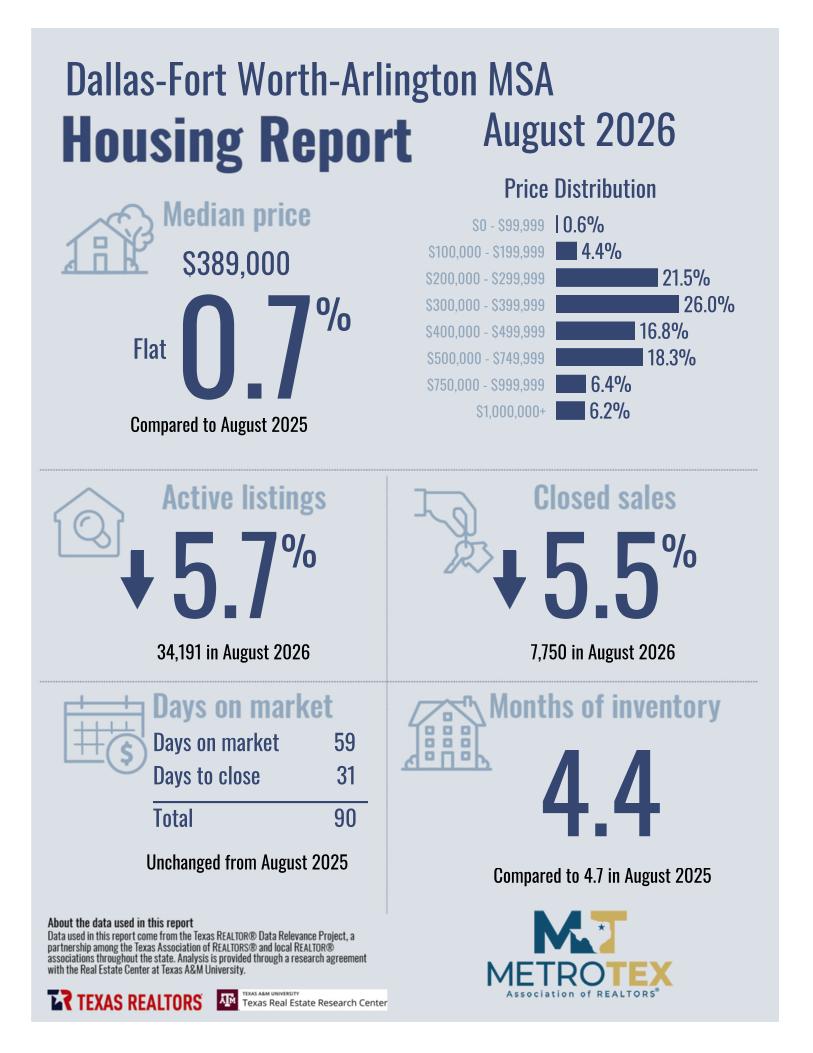
Houston vs. DFW: The Numbers

Here’s the quick snapshot:


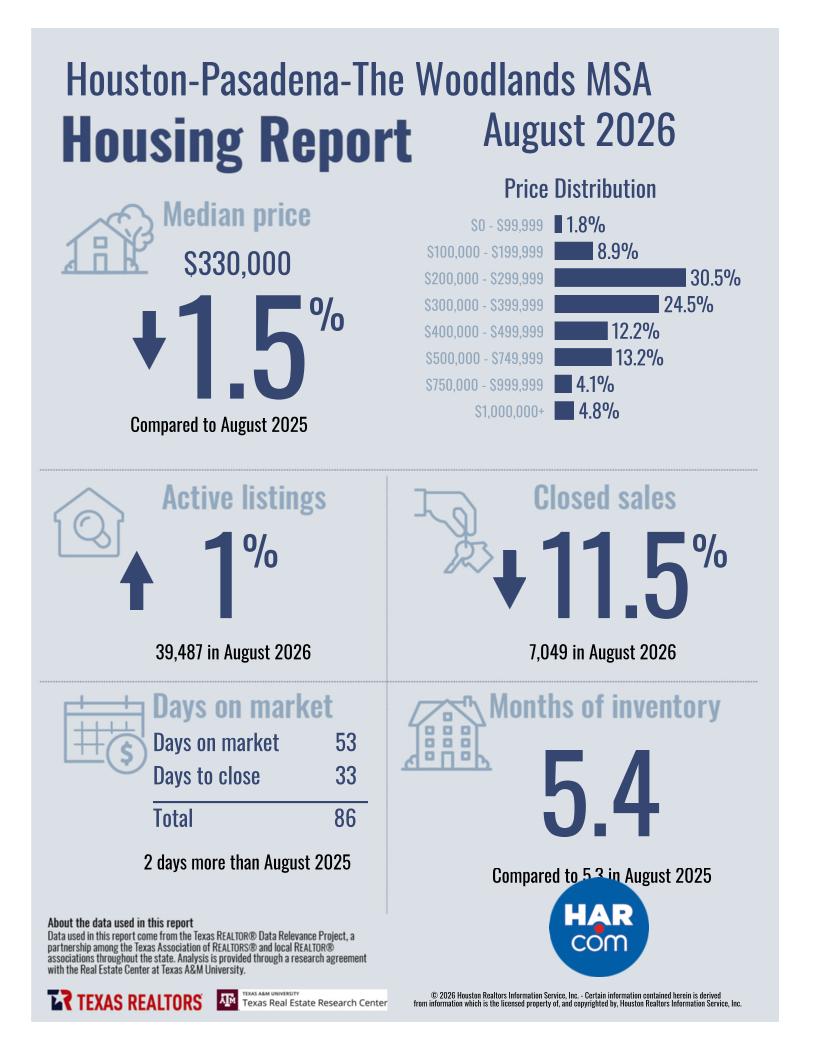
Houston Metro

DFW Metro

Median Price

$330,000

$389,000

Change from Aug. 2025

↓ 1.5%

Flat, ↓ 0.7%

Active Listings

39,487

34,191

Change from Aug. 2025

↑ 1%

↓ 5.7%

Closed Sales

7,049

7,750

Change from Aug. 2025

↓ 11.5%

↓ 5.5%

Days on Market

53

59

Months of Inventory

5.4

4.4

And right away, you can see why I don't like making sweeping statements about “the Texas market.”

Houston and DFW are telling different stories.

Houston's median price was $330,000, down 1.5% from last August. Active listings were up slightly, while closed sales were down 11.5%. Inventory was 5.4 months.

DFW's median price was $389,000, essentially flat year over year. Active listings were actually down 5.7%, closed sales were down 5.5%, and inventory was 4.4 months.

Homes were averaging 53 days on the market in Houston and 59 days in DFW.

So…what do I think the numbers are telling us?

It's Not Really About Who's “Hotter”

I could look at these numbers and say Houston is softer because prices are down and sales are down more.

I could say DFW is stronger because prices are basically flat and inventory is tighter.

And technically, those statements wouldn't be wrong.

But they're not the whole story.

Because 5.4 months of inventory doesn't mean every Houston neighborhood has 5.4 months of inventory.

And 4.4 months in DFW doesn't mean every DFW neighborhood is sitting at 4.4 months either.

There are areas within both metroplexes where buyers have the advantage.

There are areas where sellers still have plenty of leverage.

And there are price ranges where the market behaves completely differently from the metro-wide number.

That's the part I think gets lost when we throw around broad market statistics.

August Can Be a Little Weird

August is also one of those months where you have to put the numbers into context.

Kids are heading back to school. Vacations are wrapping up. Sports and activities are starting. Everyone is looking at the calendar wondering how summer disappeared so quickly.

It's perfectly normal for real estate activity to shift a little during this time.

But slower sales don't necessarily mean buyers have disappeared.

People still need to move.

Jobs change.

Families change.

People relocate.

Someone finds the house they've been waiting for.

And sometimes, a seller finally gets the price right.

That last one matters.

Price Still Matters. A Lot.

We're no longer in a market where a seller can simply put a house on the MLS, wait for the offers to roll in and assume the market will take care of the rest.

Buyers have choices.

They're looking at the competition.

They're looking at condition.

They're looking at location.

And they're asking a very reasonable question:

“Is this house worth what they're asking?”

When the answer is yes, things can happen.

And I've actually seen my own business pick up as we've moved into the back-to-school season.

Does that mean the entire market has suddenly changed?

No.

But it does remind me that real estate transactions happen because of people—not because of a statistic.

A buyer moving into the area doesn't necessarily care that closed sales are down 11.5%.

They care about finding the right house.

A seller who needs to move doesn't necessarily need the market to be “hot.”

They need to understand their competition and price their home appropriately.

And that's where having someone who knows the local market matters.

The Bigger Lesson

I started this month's series with the Texas numbers, then narrowed it down to DFW and Houston.

And we're going to keep narrowing.

Because here's what I want people to take away from these monthly reports:

The Texas market is not one market.

DFW isn't one market.

Houston isn't one market.

And even your neighborhood isn't necessarily the same market as the neighborhood five miles away.

Price point matters.

Location matters.

Property type matters.

Condition matters.

And, sometimes, the reason someone is buying or selling matters just as much as any market statistic.

So when you hear someone say:

“It's a buyer's market.”

or

“It's a seller's market.”

My first question is always:

“Where?”

Because that's where the answer gets interesting.

And next, we're getting really local.

Next up is my August look at Montgomery, Montgomery ISD and Walden.

That's where we'll take all this big-picture information and bring it home—literally.

Because the numbers tell a story. But you have to know which story you're reading.

Oh and the next time you need a Real Estate agent to give you information about your area, Call me!

For all your real estate needs, get Jacque!

Serving Montgomery, Lake Conroe, DFW & beyond.


Posted in Market Updates, TEXAS
Sept. 15, 2026

Texas Real Estate August 2026 Recap: The Numbers Tell a Story

If you’ve been following my monthly real estate updates, you already know I’m a big believer in looking at the numbers—but I’m an even bigger believer in looking at what the numbers are actually telling us.

Because here’s the thing about real estate in Texas:

Texas is a big state. Real estate is local.

What happens in Dallas may look very different from what happens in Houston, Austin, San Antonio or Montgomery. And what happens in Montgomery may look very different from what is happening just 30 minutes down the road.

So, as we wrap up August, let's start with the big picture: What is happening across Texas?

The Texas Market at a Glance

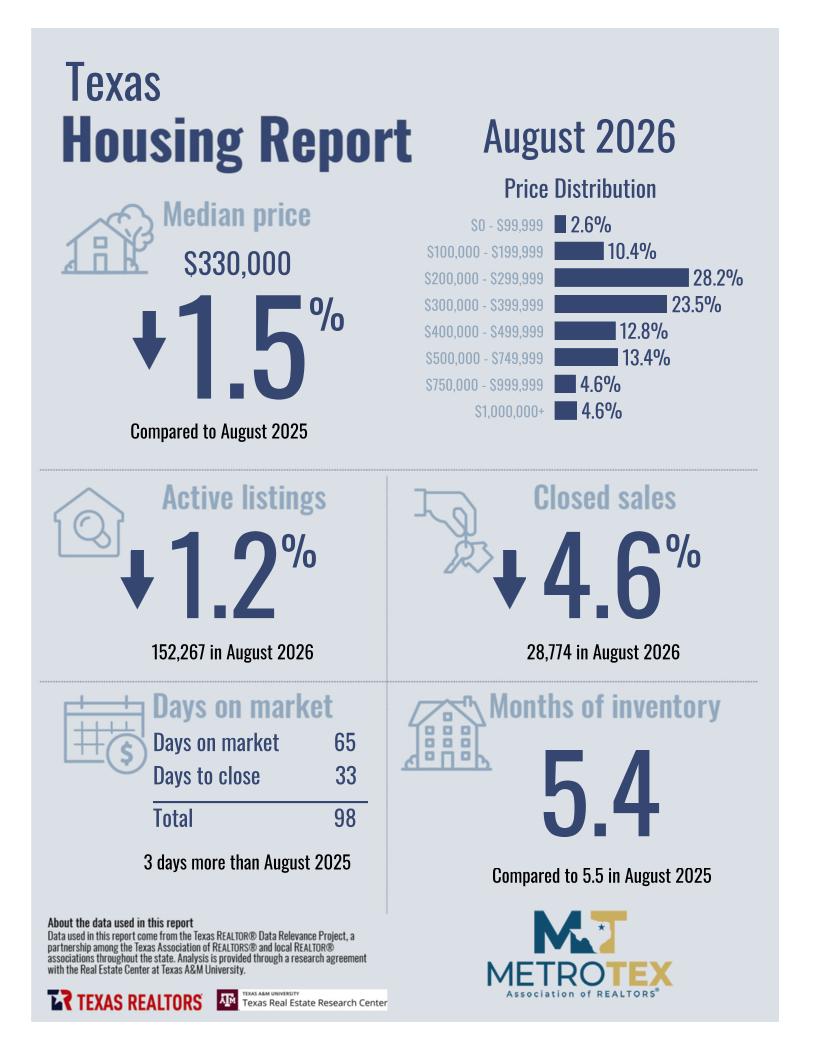
According to the August 2026 Texas market report:

  • Median price: $330,000 — up 1.5% from August 2025
  • Closed sales: 28,774
  • Days on market: 65 days
  • Days to close: 33 days
  • Total time from listing to closing: 98 days
  • Inventory: 5.4 months, compared with 5.5 months in August 2025

So, what do I see when I look at those numbers?

A market that is functioning.

Maybe not at the breakneck pace we became accustomed to a few years ago. Maybe not a market where every house gets multiple offers the first weekend.

But homes are selling.

Buyers are buying.

Sellers are selling.

And the market is finding its footing.

August Is Usually a Little Different

August can be an interesting month for real estate in Texas.

Summer is winding down, kids are heading back to school, sports and activities are starting up again, and suddenly everyone's calendar is packed.

It isn't unusual to see real estate activity slow down a little as families shift their attention back to their normal routines.

But this year, I've noticed something a little different in my own business.

Things have picked up.

Now, does that mean the Texas housing market has suddenly taken off?

Nope.

And I don't think one person's business—or even one month's numbers—can tell us that.

But it does make me stop and think about something I talk about all the time:

Sometimes it's not the market. It's the property.

When a home is priced appropriately for its location, condition and competition, buyers notice.

When a buyer has a reason to move, they're going to move.

Maybe they're relocating into the area.

Maybe they're moving closer to family.

Maybe they're finally ready to buy after renting.

Maybe life simply changed and they need a different house.

Real estate transactions don't happen because a statistic says they should.

They happen because people have a reason to move.

And when the right buyer meets the right house at the right price, things can happen—even in a market that isn't particularly “hot.”

More Choices Don't Mean No Buyers

One of the biggest changes we've seen over the last couple of years is that buyers have more choices.

Texas has been moving toward a more balanced inventory environment, and August ended with 5.4 months of inventory. That gives buyers more room to shop, compare and think.

That's not necessarily a bad thing.

In fact, I think a more normal market can be a good thing.

Buyers don't have to make a decision in 15 minutes because they are afraid someone else will grab the house.

Sellers, on the other hand, can't simply put a house on the market and assume the market will do the work for them.

Pricing matters.

Condition matters.

Presentation matters.

Location matters.

And understanding the competition matters.

The Texas Real Estate Research Center has also described the state's 2026 housing activity as relatively steady, with buyers adapting to higher mortgage rates and greater inventory choice.

That's a pretty good description of the market I'm seeing: people haven't stopped buying houses. They've simply become more thoughtful about it.

So… Is It a Buyer's Market or a Seller's Market?

Well, that's where things get interesting.

I don't love putting a giant statewide label on the Texas real estate market because there isn't one Texas market.

There are thousands of local markets.

There are neighborhoods within cities.

There are price points within neighborhoods.

And there are individual homes within those price points.

Two houses on the same street can have very different results if one is priced correctly and the other isn't.

That's why I always encourage buyers and sellers to look beyond the headlines.

“Texas home prices are up.”

“Texas home prices are down.”

“It's a buyer's market.”

“It's a seller's market.”

Those headlines may make for good social media posts, but they don't necessarily tell you what is happening with your house.

My Take on August

If I had to sum up the Texas market in one sentence, I'd say this:

The market isn't doing the work for you anymore—and that's not necessarily a bad thing.

For sellers, it means pricing strategically and understanding your competition is more important than ever.

For buyers, it means there are opportunities to take your time, do your homework and negotiate—but you still need to recognize a good property when you see one.

And for both?

It means real estate is becoming a little more… normal.

And honestly, I'm okay with that.

Because a healthy real estate market isn't one where everyone is scrambling.

It's one where buyers and sellers can make decisions based on their individual circumstances rather than fear.

And that brings me back to my favorite real estate reminder:

Texas is the big picture. Your neighborhood is the story.

Next up, I'm narrowing the lens.

We'll look at DFW vs. Houston—two major Texas markets that can tell very different stories despite being in the same state.

Because if there's one thing I've learned after years in this business, it's this:

Real estate is local. Really local.

Thinking about buying or selling? Don't let a statewide headline make the decision for you. Let's look at what's actually happening in your market, your neighborhood and your price range.

For all your real estate needs, get Jacque!
Serving Montgomery, Lake Conroe, DFW & beyond.

Posted in Market Updates, TEXAS
Sept. 11, 2026

Foodie Friday: Remembering September 11th and family.


September 11, 2026

This Foodie Friday feels a little different.

Usually, I’m talking about football, food, family and friends—and this week’s recipe, Buffalo Chicken Dip, is definitely football-food worthy.

But September 11 isn't just another Friday.

Twenty-five years later, we still remember. And I think we always should.

I remember where I was.

I was at work, a little early, listening to the radio. At first, I honestly didn't understand what they were saying.

My husband was on a train heading into Denver for work. He was going to a “tall” building.

I remember the worry.

Like so many people, we eventually went home and turned on the television. And then we watched.

And watched.

And watched it again.

We were trying to understand what we were seeing. We didn't yet know the full scope of what had happened. We certainly didn't know how many people would lose their lives that day—or how many more lives would be changed forever in the days, months and years that followed.

We didn't know.

But we knew something had changed.

And then something else happened that I don't ever want us to forget.

We came together.

Neighbors checked on neighbors. Families stayed close. People gathered. Flags appeared everywhere.

Sports became part of that healing, too.

I remember the National Anthem being sung with a different kind of feeling. I remember the Pledge of Allegiance carrying more weight. I remember watching Americans come together, regardless of where they lived, what they believed or what team they cheered for.

For a little while, we seemed to remember what we had in common.

We were Americans.

And we needed each other.

I think that's one of the things that makes this country so extraordinary.

It isn't that we never have hard days. We do.

It isn't that we always agree. We certainly don't.

It's what we do when the hard days come.

We help each other. We stand together. We find our way forward.

The hard days don't define the greatness of America—but the way we come through them does.

Those difficult moments remind us of our strength, our resilience and the incredible people who call this country home.

And maybe that's why I think about gathering around food when I think about September 11.

Because food has a funny way of bringing people together. It gives us a reason to sit at the same table, watch the game, tell stories, laugh, cry, argue about football—and simply be together.

So yes, this is a Foodie Friday post.

And yes, I'm giving you a recipe for Buffalo Chicken Dip because football season is here and, let's be honest, somebody needs to bring the good stuff.

But this week, the food is really just an excuse to talk about something bigger.

Twenty-five years later, we remember the people we lost.

We remember the first responders and ordinary people who ran toward danger while others were running away.

We remember the families who lost someone that day.

We remember the people whose lives were forever changed.

And I hope we remember the way Americans came together afterward.

This day will live with us forever.

And it should.

Not because we want to live in the sadness of that day, but because remembering reminds us of what matters.

Our people.

Our families.

Our neighbors.

Our country.

And each other.

So this weekend, when you're gathered around the television watching football, or sitting around the kitchen table with friends and family, maybe take a moment.

Remember.

Be grateful.

And enjoy the people sitting beside you.

Then pass the Buffalo Chicken Dip.

Because sometimes the simplest things—food, football, a flag, a song, a table full of people—remind us just how much we have to be grateful for.

The hard days remind us who we are. And the way we come together is what makes this the Greatest country.

September 11, 2001 — We remember.


Buffalo Chicken Dip

Ingredients

  • 2 cups cooked, shredded chicken
  • 8 oz cream cheese, softened
  • ½ cup ranch dressing
  • ½ cup Buffalo wing sauce
  • 1 cup shredded cheddar cheese
  • ½ cup shredded Monterey Jack or mozzarella
  • Green onions, optional

Directions

  1. Preheat oven to 350°F.
  2. Mix the cream cheese, ranch dressing and Buffalo sauce until smooth.
  3. Stir in the shredded chicken and cheeses.
  4. Spread into a small baking dish and sprinkle with a little extra cheese.
  5. Bake for 20–25 minutes, until hot and bubbly.
  6. Serve with celery, carrots, tortilla chips or crackers.

And my very important Foodie Friday advice:

Make more than you think you'll need.

Because there is apparently no such thing as too much Buffalo Chicken Dip when football is involved. 😂

Posted in Holiday, Recipes
Sept. 10, 2026

DATA CENTERS IN TEXAS Part 3


What Homeowners & Homebuyers Should Know


A Data Center Is Coming Near Me. What Would I Want to Know Before Buying a Home?

We've talked about what a data center is.

We've talked about what it needs to operate.

Now let's bring this back to the question I would actually ask as a homeowner:

If a data center were going to be built near my house, would I want to live there?

And honestly?

I don't know.

And I think that's okay.

Because the answer would depend on the specific project.

First, I'd want to know exactly where it is.

Not just:

“It's nearby.”

How close?

What's between the house and the facility?

Is there a road?

Another commercial property?

A tree line?

Open land?

How much of the facility will I actually see?

A home directly next to a large industrial facility is a very different situation from a home several miles away.

Distance matters.

So does everything between you and the facility.

Then I'd want to know exactly what is being built.

How large is the facility?

How many buildings?

How tall?

Is it one phase or multiple phases?

What will the finished site look like?

What type of cooling equipment will be outside?

Where will the substations be?

Will there be backup generators?

What roads will construction and employees use?

And perhaps one of the most important questions:

Is this the entire project—or just Phase 1?

Because I don't want to make my decision based only on what I'm seeing in the first set of plans.

What about noise?

I'd want to know what I'll hear during construction.

Heavy equipment.

Trucks.

Road work.

Utility construction.

And then I'd want to know what I'll hear after the facility is operating.

Cooling equipment and other mechanical systems can produce sound, and backup generators may also be part of the facility.

Maybe I won't care.

Maybe I will.

But I'd rather know before I buy.

What about the view?

This is where the 10 acres next door comes back into the conversation.

Imagine buying a home because it backs up to beautiful undeveloped land.

Today, you have trees.

Maybe wildlife.

Maybe a gorgeous sunset.

Maybe just peace and quiet.

But you don't own that 10 acres.

So what can happen there?

If that property matters to my buying decision, I'd want to investigate it.

I'd want to know:

  • Who owns it?
  • Is anything currently proposed?
  • Are there development applications?
  • Are permits in progress?
  • What does the local land-use plan allow?
  • Are roads or utilities planned?
  • Could additional development occur later?

And I'd contact the appropriate local planning, development or permitting authorities to see what information is publicly available.

That doesn't mean someone can tell me exactly what will happen ten years from now.

Nobody has a crystal ball.

But there is a big difference between:

“Nothing has been proposed.”

and

“Nothing can ever be built.”

Know the difference.

And this is not just a data-center lesson.

I've had clients who didn't want to buy near power lines.

I've had buyers who didn't want a busy road behind their house.

Some buyers don't want commercial property nearby.

Other buyers don't care.

Some people will pay more for a wooded view.

Others would rather have a grocery store five minutes away.

Buyers are individuals.

And because buyers are individuals, their perception of a property's surroundings can affect how desirable that property is.

That's why I would be very careful about making a blanket statement that a data center will automatically increase or decrease nearby home values.

The evidence isn't that simple.

The specific facility, distance, surrounding development, noise, visual impact and buyer preferences can all matter.

So instead of saying:

“Data centers lower property values,”

I'd rather say:

“If you're buying near one, understand what you're buying next to and consider how future buyers might perceive the location.”

That's a much more useful real estate conversation.

And then there's electricity.

This one is particularly personal for me because I live in Montgomery County.

If you've lived in Texas long enough, you know what happens when Mother Nature decides to remind us who's in charge.

Hurricanes.

Severe storms.

Winter freezes.

Extreme heat.

We don't wonder if we'll eventually have another major weather event. We wonder when.

So if a large new electricity user is coming into my area, I would want to know:

How will it connect to the grid?

Will new substations be required?

Will transmission lines be built?

What does the utility say about capacity?

What happens during a grid emergency?

Does the facility have backup generation?

Can it reduce its electricity demand during an emergency?

I am not saying:

“A data center will make my neighborhood lose power.”

We don't have evidence to make that claim.

I'm asking a different question:

“What protections and requirements are in place to make sure the grid can handle a very large new customer?”

That's a reasonable question.

And Texas is asking it, too.

What about water?

Living near Lake Conroe, water is another subject that gets my attention.

I've lived through Texas droughts.

I've watched lawns die.

I've watched lake levels fall.

And I know that drought restrictions can affect homeowners and businesses differently depending on the water source and local rules.

So if I'm buying near a proposed data center, I'd want to know:

Where does its water come from?

How much will it use?

What cooling technology is being used?

What happens during drought?

What does its water agreement say?

Those answers matter much more to me than a generic statement that “data centers use a lot of water.”

Here's something else I've learned while researching this series.

This is a very new and very fast-moving topic—and sometimes even the terminology can get confusing.

For example, you've probably seen stories about the massive Tesla/SpaceX Terafab project planned for Grimes County.

It is enormous—about 100 million square feet—with an initial investment announced at $16.8 billion and plans for at least 3,000 jobs.

But here's the important part:

It is not simply a traditional data center.

Terafab is a semiconductor manufacturing complex designed to produce chips for Tesla and SpaceX applications, including AI-related computing and space-based data centers.

Why does that matter?

Because if I saw a headline or social-media post saying:

“Huge AI data center coming to Grimes County!”

I might assume it was a data center.

It isn't that simple.

And that's why I think this is one of the most important lessons in this entire series:

Don't just research the rumor. Research the project.

Don't rely solely on a Facebook post.

Don't rely on a neighborhood conversation.

Don't even rely on one headline.

Find out what is actually being proposed.

Who is proposing it?

What are they building?

Where?

How large?

What has actually been approved?

What still requires approval?

What infrastructure is required?

And what can change?

Because this industry is moving incredibly quickly, the information available today may not be the information available six months from now.

And we are seeing that happen right now in Texas.

As of August 2026, Texas is conducting a statewide audit of roughly 250–300 large-load projects, most of them data centers, before they can move forward through the ERCOT interconnection process.

That means some of the projects we're hearing about today are still moving through a process.

“Planned” doesn't necessarily mean “approved.”

And “proposed” definitely doesn't mean “built.”

That's an important distinction for a homebuyer.

What about what's happening locally?

This isn't just some distant Texas issue.

Here in our region, Conroe is currently working on proposed requirements for future data-center development. The proposed rules include things such as site plans, energy and water-use studies, emergency response planning, noise and utility requirements. Conroe currently does not have a data center, but city officials say they want safeguards in place before one arrives.

That is a great example of what we've been talking about throughout this series.

A community doesn't necessarily have to wait until something is built to start asking questions.

And the rules can vary from one community to another.

So if you're concerned about a proposed project near you, don't assume the answer is the same as it would be somewhere else in Texas.

Research the specific project.

So what would I investigate before buying?

If I were seriously considering a home near a proposed data center—or any other large development—I'd want to investigate:

The project

  • What exactly is being built?
  • How large is it?
  • How many phases?
  • Who owns it?
  • What's the timeline?

Electricity

  • How will it be powered?
  • Are new substations or transmission lines planned?
  • What happens during grid emergencies?
  • Is backup generation planned?

Water

  • What is the water source?
  • How much will be consumed?
  • What cooling technology is being used?
  • What happens during drought?

The neighborhood

  • How close is it?
  • What will I see?
  • What will I hear?
  • Will lighting affect nearby properties?
  • What will construction traffic look like?

The surrounding land

  • Who owns the vacant property nearby?
  • Is anything proposed?
  • What does the local development plan allow?
  • Could additional development occur later?

And finally...the real estate question

How do buyers in this particular market feel about it?

Are nearby homes selling?

Are buyers raising concerns?

Are homes taking longer to sell?

Are there comparable properties that can help us understand the market?

Because that's how real estate works.

We don't determine value based on one person's opinion.

We look at the market.

Here's something else I want homeowners to remember.

No one is going to be able to answer every question for you.

If a particular development is coming to your area, you may have to research that specific project.

You may need to look at planning documents.

You may need to contact the city or county.

You may need to look at utility information.

You may need to read proposed development plans.

You may need to ask questions at public meetings.

And honestly?

That's not really different from any other development.

We've always had to keep up with the “progress” happening around us.

A new road.

A new neighborhood.

A shopping center.

A warehouse.

A school.

A business park.

Development changes communities.

Sometimes we welcome those changes.

Sometimes we don't.

Sometimes we love what gets built.

Sometimes we miss what was there before.

That's part of living in a growing community.

So, would I buy next to a data center?

Maybe.

Maybe not.

And I don't think there is one correct answer.

It would depend on the project, the distance, the infrastructure, the surroundings and, honestly, how I felt about living there.

Maybe someone else would look at the same property and say:

“I don't care.”

That's real estate.

Here's what I do know.

We're going to keep growing.

I'm in real estate. I understand that.

People need homes.

Businesses need places to operate.

Technology needs infrastructure.

Communities need jobs, investment and tax revenue.

But growth also changes places.

I've watched wooded land disappear.

I've watched neighborhoods replace open fields.

I've watched our lakes rise and fall.

I've lived through storms and freezes that reminded me how important reliable electricity is.

So when I hear about a major new development, I don't automatically think:

“That's good.”

And I don't automatically think:

“That's bad.”

I think:

“Okay. Tell me what it means.”

What are we building?

What does it require?

What does the community gain?

What does it give up?

What happens when water is scarce?

What happens when electricity is scarce?

What happens during an emergency?

And what does it mean for the people who live nearby?

Because whether it's a data center, a giant distribution facility, a new neighborhood or simply 10 acres of vacant land behind the house you're considering...

You're not just buying the house. You're buying the location.

We can't predict everything that will happen in the future.

But we can ask questions.

We can investigate what's already in the works.

We can look at the facts.

And we can make the best decision we can with the information available to us.

That's what I'd want to do.


A Note About This Series

Data-center development in Texas is moving quickly, and proposed projects, regulations and available information can change.

This series is intended to help homeowners and homebuyers understand the questions to ask—not to tell you what you should think about a particular project.

If you're considering a property near a proposed development, research the specific project and verify the most current information with the appropriate local agencies.

Know what it is. Know what it means. Make an informed decision.

Jacque Swanner | INC Realty
For all your real estate needs, get Jacque!


Sept. 9, 2026

Data Center Part 2


What Homeowners & Homebuyers Should Know


Data Centers in Texas: What Does It Take to Operate One?

Now that we know what a data center actually is, let's talk about what it takes to keep one running.

And this is where I started thinking:

Okay...this is bigger than a building full of computers.

Those computers operate around the clock.

They require electricity.

They generate heat.

They have to be cooled.

And depending on the facility and its cooling system, water may be an important part of that equation.

So if I were a homeowner living near a proposed data center, these are some of the questions I'd want answered.

Let's start with electricity.

Data centers can be extremely large electricity users.

Texas is already dealing with a major increase in electricity demand from data centers and other large-load customers.

In August 2026, Gov. Greg Abbott directed PUCT and ERCOT to audit roughly 250–300 large-load projects moving through the state's interconnection process, most of them data centers. State officials said the projects under review represent an enormous amount of potential future electricity demand.

But here's a very important distinction:

A request for power is not the same thing as a completed data center.

Projects can change, be delayed or never be built.

Still, the size of the requests explains why Texas is taking a closer look.

Why does electricity matter so much?

Remember all those computers?

They use electricity.

And the electricity ultimately becomes heat.

A large data center may require substantial electrical infrastructure to serve it, potentially including substations and transmission upgrades depending on its location and size.

That's why, when I hear about a proposed data center, I don't just want to know:

“How much electricity will it use?”

I also want to know:

“How will it get that electricity?”

Will existing infrastructure be enough?

Will a new substation be needed?

Will transmission lines need to be added?

What does the utility say about capacity?

Those are community questions—not just data-center questions.

And then there is Texas weather.

This one matters to me personally.

I've lived in Texas long enough to know that the question isn't always if we will have an extreme weather event.

It's when.

Hurricanes.

Severe thunderstorms.

Ice.

Winter freezes.

Extreme heat.

We've all seen situations where electricity is interrupted or the grid is under stress.

So if a very large new electricity user is coming into my area, I'd want to understand how the project is being incorporated into the electric system.

That doesn't mean I'm going to assume a data center will cause my neighborhood to lose power.

That's a conclusion we can't simply make.

But I do want to know:

How is the grid being prepared for the additional demand?

And:

What happens when the grid is under stress?

Those are now questions Texas regulators are actively examining.

What about water?

This is probably the question that has made me stop and think the most.

Because if you've lived in Texas for very long, you've experienced drought.

We've watched lawns turn brown.

We've watched lakes drop.

We've been told when we can and cannot water.

So naturally, when I hear that some data centers can use substantial amounts of water for cooling, my question is:

What happens during the next drought?

The answer is more complicated than I expected.

There isn't one statewide “data center drought rule.”

Texas water restrictions can depend on the source of the water and the local water provider or groundwater conservation district.

So a data center's situation depends on where it gets its water and what rules apply to that source.

Which leads me to a question I think every community considering a major water user should ask:

What does the actual water agreement say?

If the community enters a severe drought, what happens?

Does the facility have to reduce consumption?

By how much?

At what stage?

Can its cooling system operate differently?

Is there another water source?

What happens if water becomes seriously limited?

I don't think those are unreasonable questions.

And data centers don't all use the same amount of water.

This is another area where I think people can get into trouble by repeating one number.

Cooling technology matters.

Facility design matters.

Climate matters.

The computing equipment matters.

Some cooling approaches are designed to dramatically reduce water use.

So I don't think it's accurate to simply say:

“Data centers use X gallons of water.”

The better question is:

“How much water will THIS facility use, and where will that water come from?”

That is the number I want.

And water use is one of the issues being examined as part of the state's current review of data-center projects.

What about trees and green space?

This is another question I've been thinking about.

Large developments can mean large areas of land are cleared.

I've watched wooded land disappear as our area grows, and I admit it bothers me.

I like trees.

I like green space.

I like the shade they provide.

But there is a complication:

Trees need water, too.

So if we're building in a community where water is already a concern, the answer isn't necessarily to plant as many trees as possible without considering whether they can be sustained.

Maybe the better question is:

What landscaping makes sense for the climate and the available water?

Can existing mature trees be preserved where practical?

Can green space be incorporated into the development?

Can drought-tolerant landscaping provide shade without creating another major water demand?

Again, I'm not saying there is one perfect answer.

I'm saying we should ask.

And there are benefits, too.

It's important that we don't lose sight of that.

Data-center development can create construction jobs, specialized employment and economic activity.

Large projects can also involve significant investment in utilities and infrastructure.

Depending on the project and local agreements, they can contribute to the tax base as well.

So this isn't a simple story of “data centers are bad.”

There are potential benefits.

There are potential concerns.

And there are a lot of details between those two things.

If I were sitting at a community meeting about a proposed data center...

I'd want to hear answers to these questions:

Electricity

  • How much power will it require?
  • How will it connect to the grid?
  • Are new substations or transmission lines needed?
  • What happens during a grid emergency?

Water

  • How much water will it actually consume?
  • What cooling technology will be used?
  • Where will the water come from?
  • What happens during drought?

Land

  • How much land will be cleared?
  • What trees or natural areas will be affected?
  • What supporting infrastructure is required?

Community

  • How many construction jobs?
  • How many permanent jobs?
  • What economic benefits are expected?
  • What are the long-term plans for the site?

Those seem like reasonable questions to me.

And Texas is asking many of these same questions right now.

That doesn't mean every question has an answer yet.

It means we're asking them.

And that brings us to the final question:

If I'm actually buying a home near one, what should I investigate?

That's Part 3.


Know what it is. Know what it means. Make an informed decision.

Jacque Swanner | INC Realty
For all your real estate needs, get Jacque!


Sept. 8, 2026

Data Centers in Texas - Part 1


What Homeowners & Homebuyers Should Know


Data Centers in Texas: What Exactly Are They—and Why Should I Care?

I'll admit something.

Until recently, I couldn't have given you a very good explanation of what a data center actually does.

I'd heard the term. I knew it had something to do with computers, artificial intelligence and “the cloud.” And I'd certainly heard a lot about data centers being built in Texas.

But if someone had asked me, “Jacque, what exactly happens inside one?” I probably would have given them a pretty vague answer.

So I decided to find out.

And the more I learned, the more I realized this isn't just a technology story.

It's a community story. And for those of us in real estate, it's also a location story.

Because if someone told me a large data center was going to be built near my home, I'd have questions.

So let's start with the most basic one.

What exactly IS a data center?

In the simplest terms, a data center is a facility that houses computer servers and other equipment used to store, process and move digital information.

Think of it as a giant, highly specialized building full of computers.

Those computers support many of the things we use every day—cloud storage, websites, online banking, streaming, business applications, social media and increasingly, artificial intelligence.

When we say something is “in the cloud,” it isn't floating around somewhere above us.

The cloud is ultimately computers and servers sitting somewhere.

And those computers need somewhere to live.

That's what a data center provides.

So why are we suddenly hearing so much about them?

We've always needed data centers.

What's changed is how much computing we're doing.

We're storing more information, using more online services and increasingly using artificial intelligence that requires enormous amounts of computing power.

More computing means more servers.

More servers mean more facilities.

And those facilities require land, electricity, cooling systems, communications infrastructure and, depending on the design, water.

Texas has become a major destination for this growth.

A June 2026 Texas Tribune analysis identified at least 248 planned data centers in Texas, based on industry databases and research. The planned projects are spread throughout the state, with significant concentrations in several regions.

But here's an important distinction:

Planned does not mean guaranteed.

A project can change, be delayed, be canceled or never make it through the necessary approvals and infrastructure requirements.

And right now, Texas is taking a much closer look at these projects.

In August 2026, Gov. Greg Abbott directed the Public Utility Commission of Texas and ERCOT to audit data centers moving through the state's electric-grid interconnection process. The audit must be completed before those projects can move forward with grid connections.

So this is very much a developing story.

Why Texas?

There are several reasons.

Texas has available land, major population centers, extensive fiber infrastructure and a large energy market.

Companies looking to build large facilities also look at the availability and cost of power, water, land and connectivity.

And Texas has something else:

Room to grow.

But growth always comes with questions.

Do data centers create jobs?

Yes—but this is one of those questions where I think we need to look beyond the headline.

Building a large data center can create significant construction and infrastructure employment. Electrical, mechanical, engineering, technology, security and other specialized workers may be involved.

Once the facility is operating, it still requires people to maintain the building, equipment, security and technology.

But a giant building does not necessarily mean hundreds or thousands of permanent employees.

So if a community is told a proposed data center will create jobs, I'd want to know:

How many?

How many are construction jobs?

How many will be permanent?

What types of jobs are they?

Those are much more useful questions than simply hearing that a project will create jobs.

Okay, but why should a homeowner care?

This is where my real estate brain kicks in.

I've had clients who absolutely did not want to purchase a home near power lines.

Other buyers don't care about power lines at all.

Some don't want to back up to a busy road.

Some don't want commercial property nearby.

Others love being close to shopping, restaurants and businesses.

There isn't one list of things that bothers every buyer.

What one person considers no big deal can be a deal-breaker for someone else.

And that's important because a home doesn't exist in a vacuum.

Its location, surroundings, views, traffic, noise and nearby development can all affect how attractive it is to a future buyer.

That doesn't mean a data center automatically lowers the value of nearby homes.

It means anything that affects a property's desirability can potentially affect its marketability, and buyers have different ideas about what they want to live near.

What if the data center isn't there yet?

Here's another real estate question I think is important.

Let's say you're looking at a beautiful home next to 10 acres of open land.

Today, that's your view.

Maybe there are trees.

Maybe there is wildlife.

Maybe it's simply peaceful.

But who owns those 10 acres?

And what can eventually be built there?

We can't predict the future.

But we can investigate what is already happening.

If that property matters to my decision, I'd want to find out whether there are development applications, permits or other proposals already in the works.

I'd want to check available public information and contact the appropriate local planning, development or permitting department.

That doesn't mean someone can tell me what will happen five or ten years from now.

It means I'm doing my due diligence.

Because there's a big difference between:

“Nothing is planned right now.”

and

“Nothing can ever be built here.”

Those are two very different statements.

And I'll admit something else.

I live in Montgomery County, and I've watched our area grow.

I understand it.

I'm in real estate. People need homes. Businesses need places to operate. Communities need roads, utilities and infrastructure.

But I've also watched large wooded areas get cleared for development.

And I'll be honest:

Sometimes I drive past those areas and feel a little sad.

I liked the trees.

I liked the open land.

I understand why it's happening, but that doesn't mean I don't notice what has been lost.

I don't think that makes growth bad.

I think it means we should be willing to ask whether we can grow thoughtfully.

What does the community gain?

What changes?

What infrastructure is required?

What happens to the land?

And what does the community give up?

Those questions apply to data centers, distribution centers, new neighborhoods and all kinds of development.

So why am I learning about data centers?

Because if one were being built near my home, I would want to know more than:

“It's a data center.”

I'd want to know:

How big is it?

How close is it?

What does it require?

How much electricity?

How much water?

What kind of infrastructure?

How many jobs?

What will I see?

What will I hear?

And what happens to the surrounding area?

That's what we'll explore in Parts 2 and 3.

Because now that we know what a data center is, the next question is:

What does it actually take to operate one?


Know what it is. Know what it means. Make an informed decision.

Jacque Swanner | INC Realty
For all your real estate needs, get Jacque!


Sept. 4, 2026

Foodie Friday: When the Play Doesn’t Go as Planned


Brisket & Jalapeño Cornbread Bites with Chili Beans

Football season is here, which means it’s time to kick off another season of Foodie Friday!

And I figured there was no better way to start than with something that involves brisket, cornbread, jalapeños and a little improvising.

Because, as I learned this week, sometimes the play you planned isn't the play you're going to run. 😂

The Game Plan

We had some leftover brisket, and I’m always looking for ways to turn leftovers into something new instead of just reheating the same meal again.

I also had a couple of roasted jalapeños left over from the fajitas we picked up on Sunday.

I took those little babies, removed the seeds, chopped them up and thought, Yep. These are going in some cornbread.

So I grabbed a box of cornbread mix, prepared it according to the package directions, chopped up some brisket and got out my mini muffin pan.

I sprayed the pan with Pam and thought I was ready to go.

Except I made one little mistake.

Instead of mixing the brisket into the cornbread batter, I put the brisket into the muffin tins first and poured the cornbread mixture over the top.

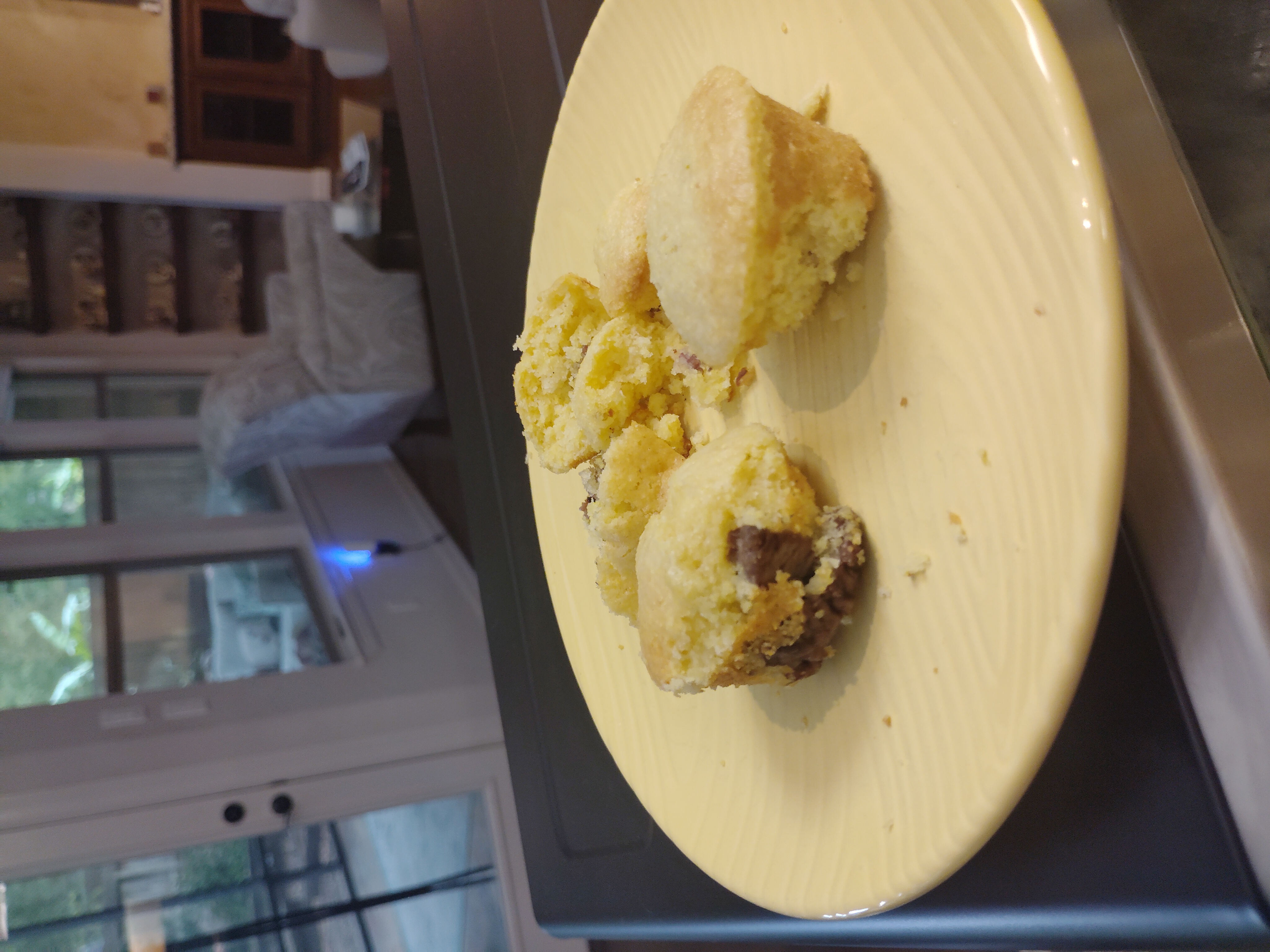
FUMBLE. 🏈

Even with the pan sprayed, that brisket decided it had found its forever home.

Some of my little muffins came out just fine.

Others?

Well…let's just say they weren't going to win any beauty contests. 😂

But Here's the Thing…

They tasted AMAZING.

The roasted jalapeños were fantastic in the cornbread, and the smoky brisket with that little kick of pepper was exactly what I was hoping for.

They just didn't look quite the way I had pictured them.

So I did what you do when a play doesn't work:

I PIVOTED.

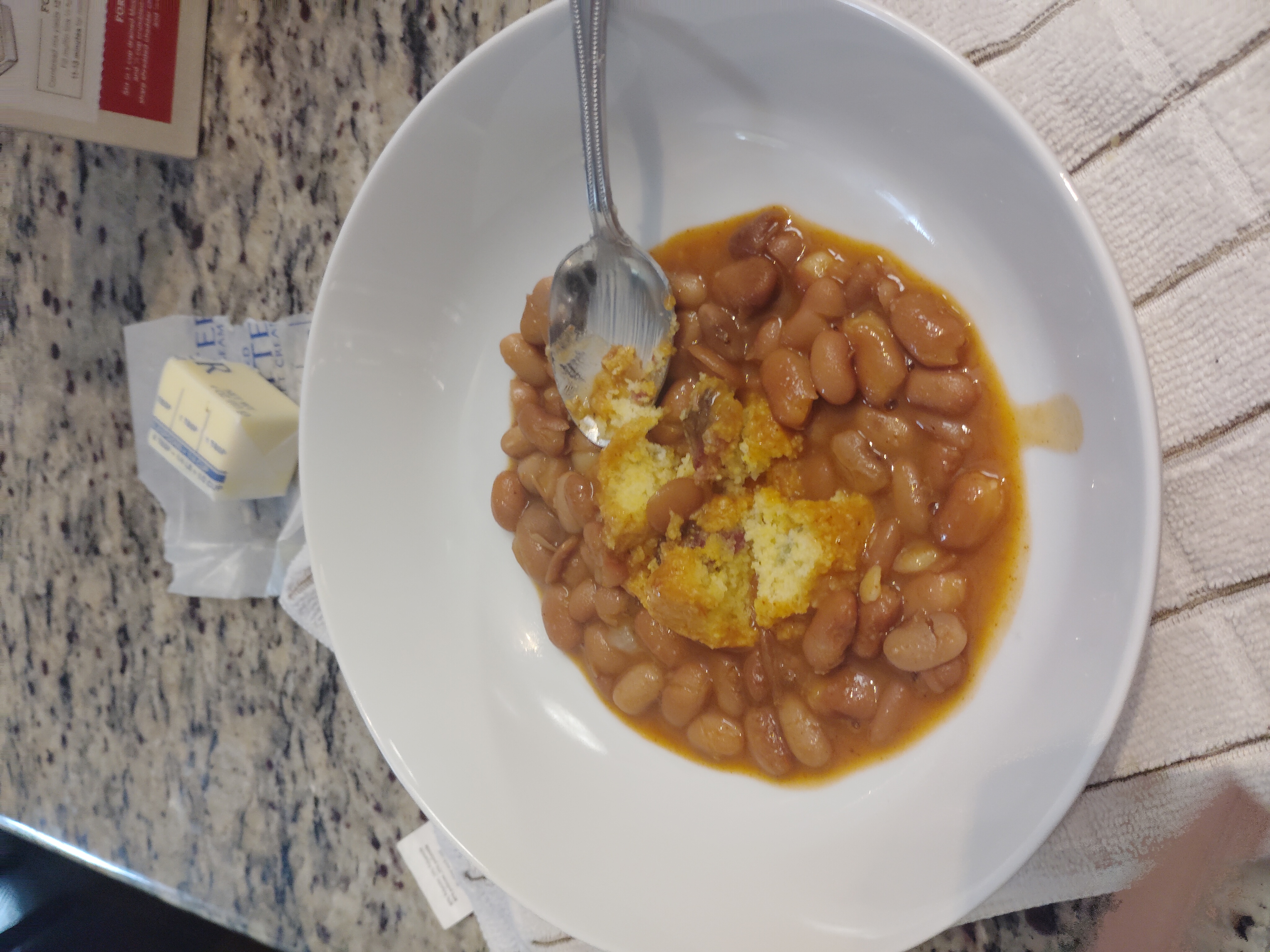
I made some chili beans, put my not-so-perfect brisket cornbread bites right on top, and suddenly I had something even better.

The warm chili beans, smoky brisket, sweet cornbread and roasted jalapeño all worked together beautifully.

Touchdown. 🏈

🌽 Brisket & Jalapeño Cornbread Bites

You'll need:

  • Leftover brisket, chopped into small pieces
  • 1–2 roasted jalapeños, seeds removed and finely chopped
  • 1 box of your favorite cornbread mix
  • Ingredients called for on the cornbread mix
  • Cooking spray
  • Your favorite chili or chili beans for serving

Here's what I'd do next time:

Prepare the cornbread mix according to the package directions.

Stir the chopped brisket and roasted jalapeños directly into the batter.

Spray a mini muffin pan well with cooking spray and fill each cup about ¾ full.

Bake according to the cornbread mix directions, checking them a little early since mini muffins cook faster than a regular pan.

Serve them on their own, alongside chili—or do what I did and put one right on top of a bowl of chili beans.

And Don't Forget the Leftovers!

That's probably my favorite part of this recipe.

The brisket was leftover.

The jalapeños were leftover from Sunday night's fajitas.

And with a box of cornbread mix and a little creativity, they became something completely different.

I love recipes like that.

You don't always need a complicated recipe or a long grocery list. Sometimes you just need to look around the refrigerator and see what you can turn into something good.

And if your first attempt doesn't look exactly like you planned?

That's okay.

Adjust the play. Keep going. And make dinner.

Because sometimes the best recipes come from a little bit of leftover food, a little bit of creativity, and a whole lot of “Well…let's see what happens.” 😂

🏈 Welcome to Football Season!

Whether you're watching college football on Saturday or the pros on Sunday, I think we've got the perfect excuse to gather around the table, share some food and enjoy the game.

And if things don't go according to plan?

Just pivot.

That's what I'm doing.

Happy Football Season & Happy Foodie Friday!


For all your real estate needs, get Jacque!
Serving Montgomery, Lake Conroe, DFW & beyond.

#GetJacque #INCrealty #FoodieFriday

Posted in Recipes
Sept. 3, 2026

Real Estate Is Hyper-Local: Why You Shouldn't Believe Every Real Estate Reel You See


Know what’s coming. Know what it means. Make an informed decision.

If you've spent any time on social media lately, you've probably seen them:

“Home prices are crashing!”

“The housing market is about to explode!”

“Buyers are disappearing!”

“Inventory is exploding!”

“Agents are quitting—and that's why homes aren't selling!”

Some of these statements may contain a piece of truth.

But here's the problem:

A piece of truth isn't necessarily the whole story.

And when you're making a decision involving one of the largest financial assets you'll ever own, I think you deserve more than a 30-second reel designed to get you to stop scrolling.


Real Estate Is Hyper-Local

There isn't one housing market.

There is the U.S. housing market.

Then Texas.

Then Houston.

Then Montgomery County.

Then Montgomery.

Then your neighborhood.

And finally, your house.

Those markets can all be doing something different at the same time.

One neighborhood may have multiple offers while another has homes sitting on the market.

One price range may have very little inventory while another has plenty.

New construction can affect one area differently than an established neighborhood.

And a waterfront property can have a very different buyer pool than a similar-sized home several miles away.

Location matters. Price range matters. Property type matters. Condition matters.

That's what I mean when I say real estate is hyper-local.


Let's Look at a Real Example

Here's something that happened right here in our own market.

The July 2026 Montgomery County Northwest housing report showed a median sales price of $595,000, an eye-catching 48.8% increase from July 2025.

Wow.

If you saw that number in a headline or a social-media post, you might reasonably think:

“Home values in Montgomery County just went up almost 50%!”

But that's not what the statistic tells us.

There were only 15 closed sales in the report.

And when you look at those sales, they weren't all in the same price range. Six sold between $500,000 and $749,999, three were between $750,000 and $999,999, and one was over $1 million.

At the same time, the average home had been on the market 69 days, which was 24 days longer than the previous July. The report showed 8.1 months of inventory.

So is the 48.8% number real?

Yes.

Does it mean every home in the area increased in value by 48.8%?

No.

The number can be right. The conclusion can still be wrong.

That's an important distinction.

A median is affected by what actually sold during that period. When you're looking at a relatively small number of transactions, the mix of properties that sold can have a significant effect on the statistics.

That's why I don't want to look at one number and tell a homeowner, “Your house went up 48.8%!”

I want to look deeper.


And Then There's the Real Estate Reel...

I recently had a client send me a reel making this argument:

REALTORS® quit → inventory explodes → sellers panic → homes can't sell.

It certainly sounds convincing when it's delivered quickly.

But let's slow it down.

Are some real estate agents leaving the business?

Yes.

Real estate is a business, and it's a business you actually have to work at.

Agents prospect.

They follow up.

They market.

They learn changing contracts and regulations.

They work with buyers and sellers.

They manage transactions.

They build relationships.

And in a commission-based business, if you don't generate business, you don't get paid.

So yes, some people decide real estate isn't for them and leave.

But agents leaving the industry don't create houses.

Inventory is affected by homeowners deciding to sell, new construction, buyer demand, interest rates, affordability, economic conditions, seasonality and many other factors.

So if someone tells you:

“Agents are quitting, therefore inventory is exploding.”

I'd ask:

Where's the data connecting those two things?

That's the difference between reporting a fact and creating a story around the fact.


Watch Out for the "Because of This, Therefore That" Reel

This is one of the biggest things I want you to watch for online.

You'll see:

“Interest rates are falling, therefore home prices will skyrocket.”

“Inventory is increasing, therefore prices are going to crash.”

“Agents are leaving, therefore homes won't sell.”

“Home prices increased, therefore your house is worth more.”

Maybe.

Maybe not.

The first statement may be true.

The conclusion may still require a lot more information.

That's where you need to stop and look at the facts.


They're Looking for Clicks. We're Looking for Facts.

I'm not saying you shouldn't watch real estate reels.

There are plenty of knowledgeable people sharing genuinely useful information online.

And national housing trends absolutely matter.

But social media rewards attention.

A calm explanation of median prices, sales volume and inventory isn't nearly as exciting as:

“HOUSING MARKET CRASHING?! 😱

That's just how social media works.

They're looking for clicks.

I'm looking for facts.

And when I'm helping a client make a real estate decision, I want the facts that apply to their situation.


Before You Believe a Real Estate Headline, Ask These Questions

1. What market are they talking about?

The U.S.?

Texas?

Houston?

Montgomery County?

Your city?

Your neighborhood?

2. When was the information collected?

Real estate markets change constantly.

Information that was accurate months ago may not accurately describe today's market.

3. How many sales are behind the statistic?

Fifteen sales can tell you something.

It just may not tell you the same thing that thousands of sales would tell you.

4. What price range are they talking about?

The market for a $300,000 home may look very different from the market for a $900,000 home.

5. What does the rest of the data say?

Don't stop at median price.

Look at:

  • Closed sales
  • Active listings
  • Months of inventory
  • Days on market
  • Price reductions
  • Sale-to-list price
  • Price ranges
  • And what's actually happening with comparable homes

6. Who is providing the information?

And perhaps most importantly:

7. Do they actually work in the market they're talking about?

Someone can be a wonderful real estate professional and still not be the person I'd rely on for detailed information about a market they don't actually work in.

That's not an insult.

It's simply reality.


I've Been Doing This Since 2011

I've been a real estate agent since 2011, and one thing I've learned is that real estate is not a stagnant industry.

Contracts change.

Forms change.

Regulations change.

Lending changes.

Buyer behavior changes.

Seller behavior changes.

And markets change.

Constantly.

That's why I believe a good real estate professional has to keep learning and keep paying attention to what's happening locally.

Not just nationally.

Not just statewide.

Locally.


National Information Still Has Value

I don't want you to walk away thinking national housing information doesn't matter.

It does.

Interest rates, employment, inflation, housing supply, consumer confidence and the broader economy can all affect your local market.

But think of national information as context.

It shouldn't automatically be treated as an answer to what is happening with your particular property.

National data can tell you about the bigger picture.

Local data can tell you what's happening where you actually live.

And when you're making a decision about a home, that distinction matters.


So What Should You Ask?

Instead of:

“What is the housing market doing?”

ask:

“What is MY market doing?”

And then take it one step further:

“What is happening with homes like mine?”

That's the information I want when I'm helping someone buy or sell.

Because your house isn't the national median.

It isn't the Texas median.

It isn't even necessarily the Montgomery County median.

Your house is your house.

Its location, condition, features, price range, competition and neighborhood all matter.


The Bottom Line

The next time you see a dramatic real estate reel, don't automatically believe it.

Don't automatically dismiss it, either.

Question it.

Find the source.

Look at the date.

Look at the market.

Look at the numbers.

Look at what they're leaving out.

And then ask whether it actually applies to you.

Because sometimes the statistic is completely accurate.

It's the interpretation that needs another look.

Don't just follow the headline. Follow the market.

Ready to Know What Your Local Market Is Really Doing?

Whether you're thinking about buying, selling, or simply trying to understand what's happening in Montgomery County, you don't have to figure it out from a reel.

Let's look at the facts that actually apply to your neighborhood, your price range and your property.

📞 Have a question about your local real estate market? Give me a call or send me a message. I'd love to help you make sense of the numbers.

Jacque Swanner, REALTOR® | INC Realty
For all your real estate needs, get Jacque!
Serving Montgomery, Lake Conroe, DFW & beyond.

Know what's coming. Know what it means. Make an informed decision.

#GetJacque #INCrealty #TXRealEstate


Sept. 2, 2026

It’s My Birthday…

So Apparently I’m Allowed to Talk About Myself Today

Know what's coming. Know what it means. Make an informed decision.

Well, it's September 2, which means it's my birthday.

And since I spend most of the year talking about real estate, Montgomery, houses, markets, dogs, food, things happening around town and whatever random thought happens to pop into my head that morning...

I figured today I get to talk about me. 😂

Don't worry. I promise it won't last long.


So…What Have I Learned?

I've learned that I don't particularly like change.

Which is hilarious because I've had a LOT of it.

I grew up as an Army brat, so moving was just part of life.

New house.

New town.

New school.

Repeat.

And when I was younger, I wasn't always thrilled about it.

I may have occasionally been what we will politely call “dramatic.”

Okay...

I was a brat. 😂

But eventually I figured something out:

Give me a little time, and I'll make almost anywhere feel like home.

In fact, I don't really know how not to nest.

Put me in a new house and I'm unpacking.

Put me in a hotel room and I'm unpacking.

Put me somewhere for three days and I'm probably rearranging the furniture.

John has learned to just let me do it.

😂


Apparently, I Like to Be Comfortable

I like things put away.

I like my space organized.

I like to move furniture around until it feels right.

I like finding the good restaurants.

I like discovering new places.

I like walking.

I like traveling.

I like learning new things.

And apparently I like having a lot of thoughts.

Because sometimes I wake up and my brain has already written three blog posts before I've even had breakfast.

And then I think:

“I wonder if anybody actually wants to hear about this?”

Apparently some of you do.

Because you read them.

You comment.

You message me.

And sometimes you tell me, “I read your blog!”

And honestly?

That makes my day.


And Then There Are the Dogs

I've had some pretty sweet dogs throughout my life.

And if you've been around me for very long, you probably know that dogs aren't exactly an afterthought around here.

They're family.

They also have a remarkable ability to completely ignore whatever plans I had for the day.

😂

But I wouldn't have it any other way.


The Real Reason I'm Writing This

I'm not writing this because I have some profound birthday wisdom to share.

At this point in life, I've learned that sometimes simple is better.

I'm writing it because I wanted to say something that I don't say often enough:

Thank you.

Thank you to my family.

Thank you to my friends.

Thank you to my clients and customers.

Thank you to the people I've met through real estate.

And thank you to the people I've never met in person but somehow still feel like I know because we chat on Facebook.

That's one of the funniest things about social media.

I can move somewhere new and somehow still have the same people following along with me.

And I love that.


So Here's to Another Year

I'm not going to make some giant list of goals.

I'm not going to tell you I've figured everything out.

And I'm definitely not going to pretend I suddenly love change. 😂

I'll probably keep rearranging furniture.

I'll keep talking about real estate.

I'll keep exploring Montgomery and everywhere else I happen to wander.

I'll keep sharing things I think are interesting.

I'll keep taking pictures of food.

I'll keep spoiling dogs.

I'll keep waking up with random ideas.

And I'll probably keep writing about them.

Because somewhere along the way, I've realized that life is really just a collection of little moments, people, places, dogs, adventures and memories.

And I'm pretty grateful for mine.

So, thank you for being part of it.

Now...

Who's bringing the cake? 🎂😂


Thinking About Real Estate?

Okay, okay...I am still a REALTOR®. 😉

If you need help buying, selling, figuring out what your home is worth—or just want to talk real estate—I'm always happy to chat.

Jacque Swanner, REALTOR® | INC Realty
For all your real estate needs, get Jacque!
Serving Montgomery, Lake Conroe, DFW & beyond.


Know what's coming. Know what it means. Make an informed decision.

Posted in Holiday, TEXAS