If you’ve been following my monthly real estate updates, you already know I’m a big believer in looking at the numbers—but I’m an even bigger believer in looking at what the numbers are actually telling us.
Because here’s the thing about real estate in Texas:
Texas is a big state. Real estate is local.
What happens in Dallas may look very different from what happens in Houston, Austin, San Antonio or Montgomery. And what happens in Montgomery may look very different from what is happening just 30 minutes down the road.
So, as we wrap up August, let's start with the big picture: What is happening across Texas?
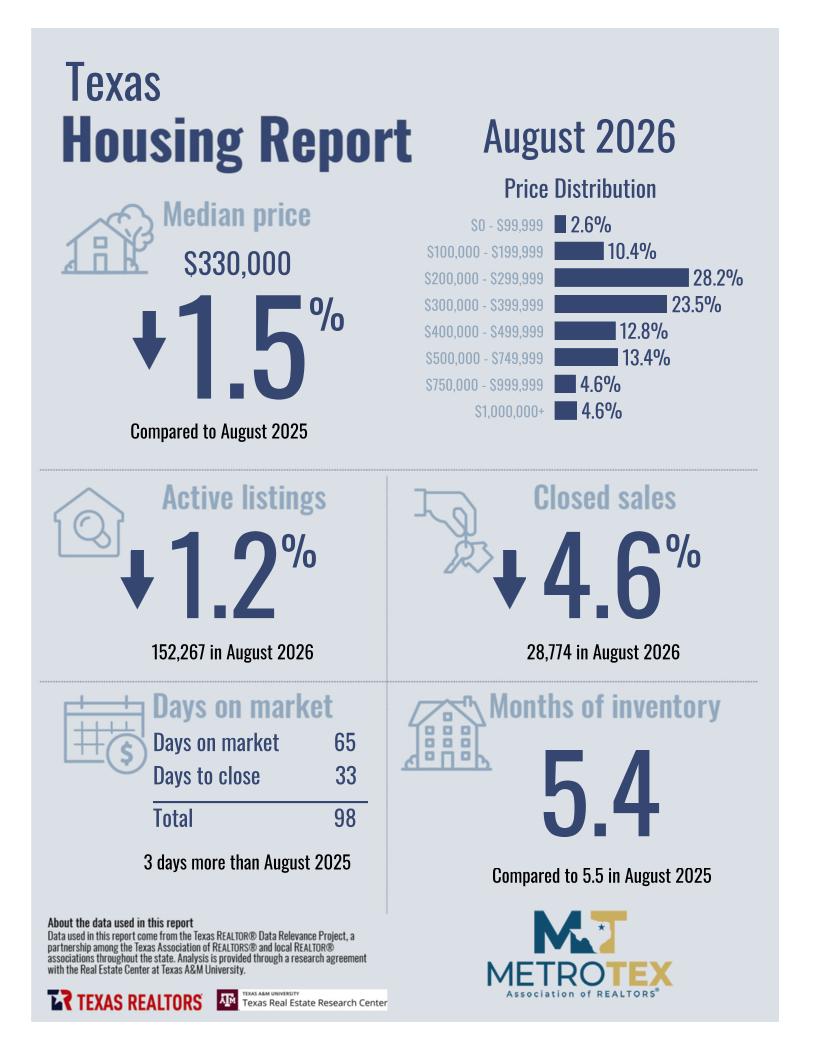
The Texas Market at a Glance
According to the August 2026 Texas market report:
- Median price: $330,000 — up 1.5% from August 2025
- Closed sales: 28,774
- Days on market: 65 days
- Days to close: 33 days
- Total time from listing to closing: 98 days
- Inventory: 5.4 months, compared with 5.5 months in August 2025
So, what do I see when I look at those numbers?
A market that is functioning.
Maybe not at the breakneck pace we became accustomed to a few years ago. Maybe not a market where every house gets multiple offers the first weekend.
But homes are selling.
Buyers are buying.
Sellers are selling.
And the market is finding its footing.
August Is Usually a Little Different
August can be an interesting month for real estate in Texas.
Summer is winding down, kids are heading back to school, sports and activities are starting up again, and suddenly everyone's calendar is packed.
It isn't unusual to see real estate activity slow down a little as families shift their attention back to their normal routines.
But this year, I've noticed something a little different in my own business.
Things have picked up.
Now, does that mean the Texas housing market has suddenly taken off?
Nope.
And I don't think one person's business—or even one month's numbers—can tell us that.
But it does make me stop and think about something I talk about all the time:
Sometimes it's not the market. It's the property.
When a home is priced appropriately for its location, condition and competition, buyers notice.
When a buyer has a reason to move, they're going to move.
Maybe they're relocating into the area.
Maybe they're moving closer to family.
Maybe they're finally ready to buy after renting.
Maybe life simply changed and they need a different house.
Real estate transactions don't happen because a statistic says they should.
They happen because people have a reason to move.
And when the right buyer meets the right house at the right price, things can happen—even in a market that isn't particularly “hot.”
More Choices Don't Mean No Buyers
One of the biggest changes we've seen over the last couple of years is that buyers have more choices.
Texas has been moving toward a more balanced inventory environment, and August ended with 5.4 months of inventory. That gives buyers more room to shop, compare and think.
That's not necessarily a bad thing.
In fact, I think a more normal market can be a good thing.
Buyers don't have to make a decision in 15 minutes because they are afraid someone else will grab the house.
Sellers, on the other hand, can't simply put a house on the market and assume the market will do the work for them.
Pricing matters.
Condition matters.
Presentation matters.
Location matters.
And understanding the competition matters.
The Texas Real Estate Research Center has also described the state's 2026 housing activity as relatively steady, with buyers adapting to higher mortgage rates and greater inventory choice.
That's a pretty good description of the market I'm seeing: people haven't stopped buying houses. They've simply become more thoughtful about it.
So… Is It a Buyer's Market or a Seller's Market?
Well, that's where things get interesting.
I don't love putting a giant statewide label on the Texas real estate market because there isn't one Texas market.
There are thousands of local markets.
There are neighborhoods within cities.
There are price points within neighborhoods.
And there are individual homes within those price points.
Two houses on the same street can have very different results if one is priced correctly and the other isn't.
That's why I always encourage buyers and sellers to look beyond the headlines.
“Texas home prices are up.”
“Texas home prices are down.”
“It's a buyer's market.”
“It's a seller's market.”
Those headlines may make for good social media posts, but they don't necessarily tell you what is happening with your house.
My Take on August
If I had to sum up the Texas market in one sentence, I'd say this:
The market isn't doing the work for you anymore—and that's not necessarily a bad thing.
For sellers, it means pricing strategically and understanding your competition is more important than ever.
For buyers, it means there are opportunities to take your time, do your homework and negotiate—but you still need to recognize a good property when you see one.
And for both?
It means real estate is becoming a little more… normal.
And honestly, I'm okay with that.
Because a healthy real estate market isn't one where everyone is scrambling.
It's one where buyers and sellers can make decisions based on their individual circumstances rather than fear.
And that brings me back to my favorite real estate reminder:
Texas is the big picture. Your neighborhood is the story.
Next up, I'm narrowing the lens.
We'll look at DFW vs. Houston—two major Texas markets that can tell very different stories despite being in the same state.
Because if there's one thing I've learned after years in this business, it's this:
Real estate is local. Really local.
Thinking about buying or selling? Don't let a statewide headline make the decision for you. Let's look at what's actually happening in your market, your neighborhood and your price range.
For all your real estate needs, get Jacque!
Serving Montgomery, Lake Conroe, DFW & beyond.