Looking to buy, sell, or just peek at the market? You’re in the right place! We serve up the latest on home values, neighborhood vibes, and community happenings – plus weekly recipes, holiday fun, and spotlights on Texas cities so you can find the home that’s just right for you.

Don’t miss our monthly market updates for Texas, D/FW, and Houston, breaking down trends, stats, and insider info so you always know what’s hot (and what’s not).

We love the communities we serve and are here to help you find your perfect home with a story – because every home deserves a little character.

Questions? Ready to make a move?
👉 Get Jacque Today!

Oct. 16, 2024

Don't Forget About Closing Costs!

Ready to Buy a Home? Don’t Forget About Closing Costs! Here’s What You Need to Know

So, you’ve decided to buy a home—congrats! As you start the process, you’re probably focused on your down payment. But one expense that often catches people off guard is closing costs. Let’s make sure you’re prepared for them, so there are no surprises when you get to the closing table.

What Are Closing Costs?

Closing costs are the additional fees and payments you’ll need to make when finalizing your home purchase. They can vary based on the price of the home and your financing, but every buyer faces these costs. It’s important to budget for them upfront so they don’t come as a shock.

According to Freddie Mac, closing costs typically include:

  • Application fees
  • Credit report fees
  • Loan origination fees
  • Appraisal fees
  • Home inspection fees
  • Title insurance
  • Homeowners insurance
  • Survey fees
  • Attorney fees

Some of these are one-time expenses baked into your closing costs. Others, like homeowners’ insurance, are ongoing responsibilities that start with your first payment at closing.

How Much Are Closing Costs?

So, how much should you expect? According to Freddie Mac, closing costs usually range from 2% to 5% of the purchase price of your home.

For example, if you’re buying a home at today’s median price of $422,600, you could be looking at closing fees anywhere between $8,452 and $21,130. Keep in mind, this can vary depending on where you’re buying and the specific price of your home.

How To Lower Your Closing Costs

Now, you might be wondering if there’s a way to reduce those costs. Here are a few tips to help ease the load:

  • Negotiate with the Seller: In today’s market, homes are staying on the market a bit longer, which means sellers may be more willing to negotiate. You can ask for concessions like having the seller cover some of your closing costs or pay for things like the home inspection. Don’t hesitate to use this as a negotiation tool.

  • Shop Around for Home Insurance: With rising home insurance costs in many areas, take the time to compare quotes. Different companies offer different rates and coverage options, so find a policy that gives you solid coverage at a competitive rate.

  • Look Into Closing Cost Assistance Programs: Just like there are programs to help with down payments, there are also programs designed to assist with closing costs. These vary by location and income level, so it’s worth looking into what’s available in your area. Your real estate agent can help point you in the right direction, and the U.S. Department of Housing and Urban Development (HUD) offers a helpful resource to find assistance programs in every state.

Bottom Line

Planning for closing costs is a key part of the homebuying process. While these costs can add up, there are ways to manage them and even reduce them with the right strategies. If you have questions or need expert advice, working with a trusted real estate team—your agent and lender—can make all the difference.
Posted in Buyers Info
Oct. 15, 2024

Are Home Prices Really Dropping?

Are Home Prices Really Dropping? Here’s What’s Actually Happening in the Market

You might’ve seen headlines lately talking about the median asking price of homes dropping compared to last year. That’s caused quite a bit of confusion, and it’s understandable why. If you’re a buyer or seller, you could be thinking that means prices are finally coming down. But here's the catch—those headlines don’t tell the full story.

In reality, home values are still rising nationally, despite the dip in median asking price. Let’s break it down so you can get a clearer picture of what’s really happening and not get caught up in the fear the media is stirring.

Why the Median Price Is Misleading: It’s All About Home Size

The biggest reason for the drop in the median price comes down to one simple thing: the size of homes being sold. The median price is just the middle point of all homes listed at any given time. So, if more smaller homes hit the market, the median price naturally drops. But that doesn’t mean home values are decreasing.

Think of it like this: imagine you have three coins in your pocket. If you line them up from lowest to highest, the one in the middle is the median. If you’ve got a nickel and two dimes, the median is 10 cents. If you have two nickels and one dime, the median becomes 5 cents. Did the value of a dime or a nickel change? Nope. That’s exactly what’s happening with the housing market right now. More smaller, less expensive homes are on the market, so the median price is coming down—but home values themselves are still growing.

As Danielle Hale, Chief Economist at Realtor.com, puts it:

"The share of inventory of smaller and more affordable homes has grown, which helps hold down the median price even as per-square-foot prices grow further."

Price Per Square Foot Is the Key


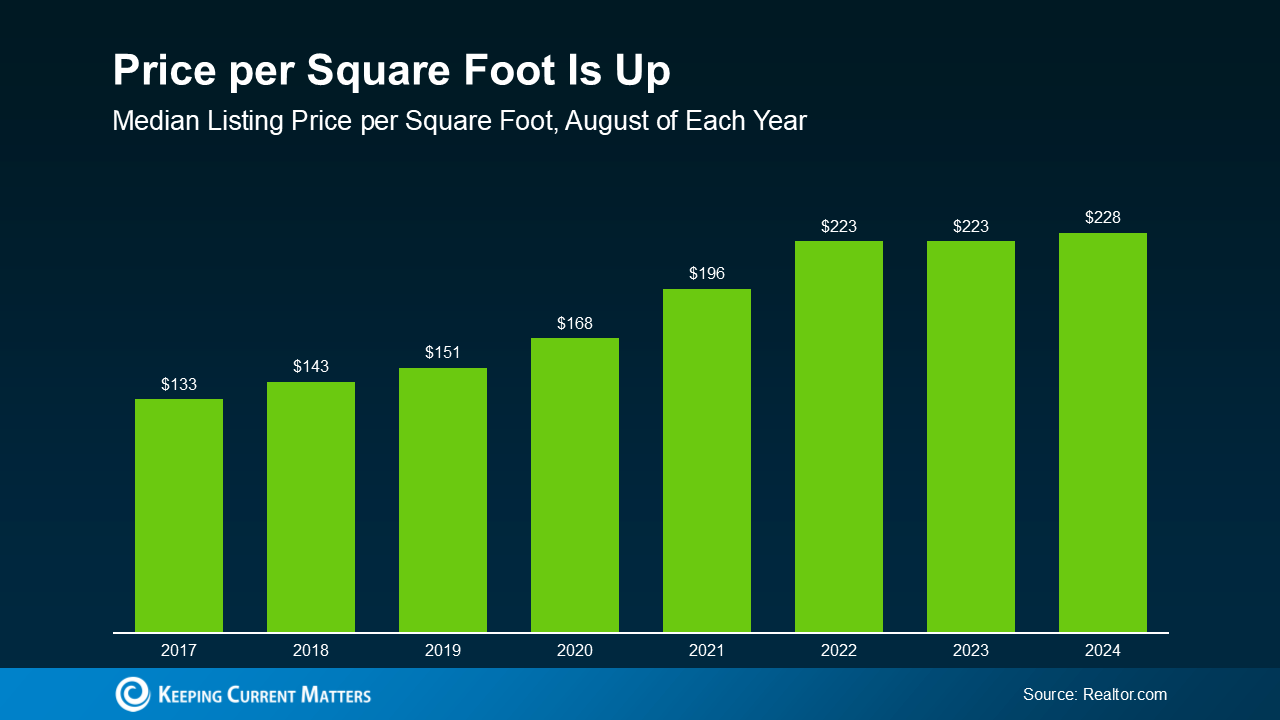
A better way to measure what’s really happening with home values is by looking at the price per square foot. This is a much clearer indicator because it shows how much you’re paying for the space inside the home, regardless of size.

The median asking price doesn’t factor in home size, which is why it can be misleading. If we look at the national data, prices per square foot are still going up, even though the median price might show a decline.

Ralph McLaughlin, Senior Economist at Realtor.com, explains it perfectly:

"When a change in the mix of inventory toward smaller homes is accounted for, the typical home listed this year has increased in asking price compared with last year."

This means that even though there are more smaller homes on the market pulling the median price down, the value of the average home is still on the rise. According to the Federal Housing Finance Agency (FHFA):

"Nationally, the U.S. housing market has experienced positive annual appreciation each quarter since the start of 2012."

What This Means for You

So, before you start worrying about a price drop, take a closer look. Yes, the median price is down, but that’s not the same thing as a decrease in home values. The important metric to watch is price per square foot, which gives a better picture of what’s happening in the market—and those numbers are still climbing.

That said, remember that real estate is local. While national trends are helpful, every market has its own dynamics. The best way to understand what’s going on in your neighborhood is by connecting with a trusted local agent who can provide you with up-to-date insights.

Bottom Line

The drop in median price is mostly due to a surge of smaller, less expensive homes hitting the market. It doesn’t mean that home values are falling. In fact, price per square foot—a better indicator of real estate trends—continues to rise. If you’re curious about what’s happening in your specific area, don’t hesitate to reach out—I’m here to help!

Posted in Buyers Info
Oct. 10, 2024

Equity Matters


Thinking About Selling Your Home? Here’s Why Your Equity Matters

There are a lot of reasons why you might be thinking about selling your home. Maybe you’re ready to downsize, relocate to your dream destination, or move closer to family and friends. But as you weigh your options, one big question might be holding you back: how are you going to afford your next home in today’s housing market? If affordability is your main concern, one key factor you might be overlooking is your home equity. Knowing how much equity you’ve built up can make your decision to sell much easier. Let’s dive into two big factors that influence your home equity.

1. How Long You’ve Been in Your Home

The first thing to consider is how long you’ve been living in your current home. This is referred to as homeowner tenure, and it plays a huge role in how much equity you have. Historically, homeowners used to move every six years, but that trend has changed. According to the National Association of Realtors (NAR), the average tenure has climbed to 10 years.

Why is that important? Well, the longer you’ve been paying down your mortgage, the more equity you’ve likely built up. Plus, home prices have appreciated over time. So, if you’ve been in your home for a decade, those two factors combined could mean you’re sitting on a sizable amount of equity without even realizing it.


2. Home Price Appreciation Over Time

Let’s talk about how home prices have appreciated over the years. Even though prices vary by area, the overall trend has been upward. Data from the Federal Housing Finance Agency (FHFA) shows that homes have significantly increased in value over time. If you’ve owned your home for just five years, you might have seen nearly a 60% increase in its value. And if you’ve been in your home for 30 years, your property value could have more than tripled.

This appreciation isn’t just a fun fact—it’s a game-changer when it comes to selling. Your home equity can give you a financial boost when buying your next home. Whether you’re moving to a smaller place or upgrading to your dream home, the equity you’ve built can be the key to making your next move more affordable.


Bottom Line

If you’re thinking about selling but are concerned about affordability, understanding your home equity is a great first step. You may have more equity than you think, and that can open doors to new possibilities. Reach out to a local real estate expert to find out how much equity you’ve built up over the years and how you can use it to fund your next chapter.

Ready to explore your options? Let’s connect and see how your home equity can make your next move easier.

Posted in Seller Info
Oct. 9, 2024

Elevate your lifestyle!

Elevate Your Lifestyle: Why Now is the Time to Invest in Luxury Living

When we think about luxury living, it’s easy to get caught up in stunning views and the latest smart home tech. But true luxury is about elevating your entire lifestyle. If you're eyeing a million-dollar home, the current luxury market offers exciting opportunities. Here’s why now is the perfect time to dive in.

A Boom in Luxury Homes

Luxury homes, typically the top 5% of listings in any area, are becoming increasingly abundant. According to a recent Redfin report, the median sale price for these homes has reached an impressive $1.18 million, marking a 9% increase year-over-year. This growth means more options for buyers, each showcasing unique features and styles.

Whether you’re after a sleek modern kitchen with high-end appliances, exclusive amenities, or a peaceful retreat with enhanced privacy, the luxury market is flourishing with choices.

Investing in Your Future

A luxury home is more than just a place to live; it’s an investment in your future. With prices on the rise, many savvy buyers are turning to luxury real estate to build long-term wealth. The August Luxury Market Report shows robust growth, with single-family home sales up 14.82% and attached homes up 11.35% compared to last year.

The Bottom Line

With a growing selection of million-dollar homes and an upward trend in prices, the luxury market is brimming with possibilities. This is your chance not just to find a dream home, but also to make a smart investment. Ready to explore the best luxury homes in your area? Connect with a local real estate agent today and take the next step toward your elevated lifestyle.

4o mini
Posted in Market Updates
Oct. 8, 2024

Why Your Asking Price Might Be Hurting Your Sale

Why Your Asking Price Might Be Hurting Your Home Sale

Every seller wants to sell their home quickly, for the best price, and with minimal stress. If you're in this boat, you’re not alone!


But here’s the kicker: one of the biggest factors that can derail your selling success is your asking price. Getting it right is crucial, and sometimes it can be tricky. So, how do you know if you’re setting yourself up for failure? Here are four signs that your high asking price could be pushing potential buyers away—and why your real estate agent is your best ally in navigating this.

1. Few Showings or Offers? It Might Be Time to Reassess.

If your home has been on the market for weeks with little to no interest, that’s a red flag. Buyers who’ve been hunting can spot an overpriced home from a mile away. If you’re not seeing many showings or offers, it’s likely time to rethink your price point. Your real estate agent can provide valuable insights on pricing strategies and may suggest a price cut to attract more buyers.

2. Consistent Negative Feedback from Showings? Take Note!

If potential buyers are giving you the same critiques after each showing, it’s tim

e to listen. Feedback is a goldmine for understanding how your home is perceived. If buyers consistently mention that your home feels overpriced compared to others they’ve seen, it’s a sign to revisit your pricing strategy. Your agent will gather and analyze this feedback, helping you see where adjustments can be made to better align with buyer expectations.

3. Sitting on the Market Too Long? That’s a Problem.

A home that lingers too long can raise eyebrows. In today’s market, if your listing is stagnant while others are selling, it could signal that your home is stale. Buyers might wonder if there’s something wrong with it. Check in with your agent to understand how quickly homes in your area are selling. If yours has been on the market significantly longer, it’s likely time to consider a price adjustment.

4. Neighbors’ Homes Are Selling Faster? Keep an Eye on the Competition.

If homes similar to yours are flying off the market while yours sits idle, it’s a clear indication something isn’t right. It could be your price, outdated features, or lack of upgrades. Your agent will keep you informed about local sales trends and can offer advice on enhancements that could boost your home’s appeal, making it more competitive.

Final Thoughts

Pricing your home effectively is both an art and a science. It requires a keen understanding of the market and what buyers are looking for. If your price isn’t generating interest, don’t hesitate to lean on your real estate agent. Their expertise can guide you in making the necessary adjustments to attract buyers and close the deal.

Remember, it’s all about creating a strategy that works for you—and sometimes that means being willing to adapt to what the market is telling you!

Posted in Seller Info
Sept. 30, 2024

Is it time to BUY!

Is It Time to Buy? Monthly Mortgage Payments Are Lower Than Rent in Many Areas!

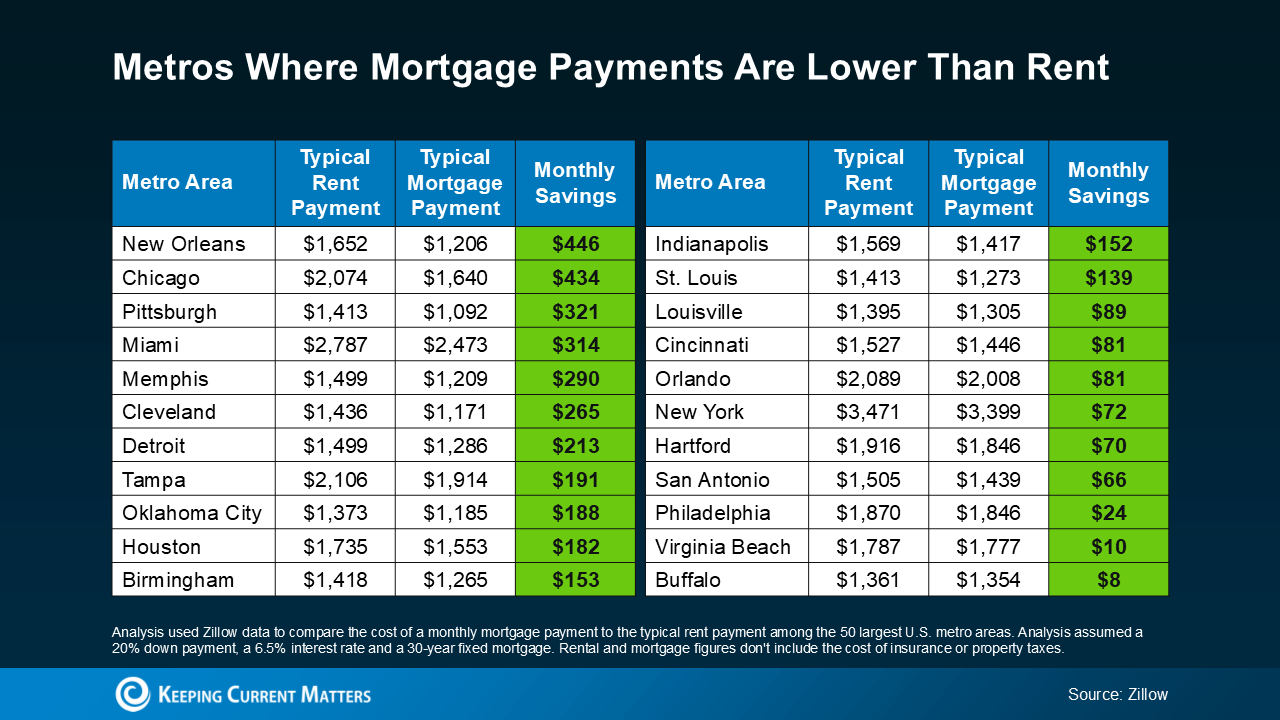
Great news for renters! According to a recent Zillow study, in 22 of the 50 largest metro areas, monthly mortgage payments are now actually lower than rent. That’s a game changer!

As mortgage rates have eased off their recent highs and home prices have stabilized, affordability is looking much better these days. Inventory is also on the rise, which means there are more options for buyers. If you’ve been renting and dreaming of owning a home, now might be the perfect time to make that dream a reality.

Even if your city isn’t on the list yet, don’t panic! The market is changing rapidly, and your area could soon follow suit. This is why it’s crucial to talk to a local real estate agent who knows the ins and outs of your neighborhood. They can help you understand the current market and see what’s becoming more affordable.

While the study focuses on principal and interest for mortgage payments, remember to factor in other costs of homeownership—like taxes, insurance, and maintenance. But don’t forget that renters also face extra expenses like renters’ insurance, utilities, and parking.

So, grab your calculator and have a chat with your agent! It’s a great time to reassess whether buying a home makes sense for you.

As Orphe Divounguy, Senior Economist at Zillow, says, “For those who can make it work, homeownership may come with lower monthly costs and the ability to build long-term wealth in the form of home equity—something you miss out on as a renter.”

Whether you’re in one of the budget-friendly metros or anywhere in between, connecting with a local real estate expert can help you navigate these changes and seize opportunities before they slip away.

Bottom Line

If you’re tired of renting and want to see if now’s the right time for you to buy a home, reach out to a local real estate agent. Together, you can crunch the numbers and explore your options!

Posted in Market Updates
Sept. 25, 2024

Ready to buy a home?

Ready to Buy a Home? Here’s Why You Need to Get Pre-Approved First

With more homes hitting the market and mortgage rates starting to ease up, it might feel like the right time to finally take the plunge and start your home search. But before you dive in, there’s one crucial step you don’t want to skip: getting pre-approved for a mortgage.

What’s a pre-approval, you ask? It’s when a lender takes a deep dive into your finances—things like your W-2s, tax returns, credit score, and bank statements—to figure out what they’re willing to loan you. Once that process is done, you’ll get a pre-approval letter that tells you how much you can borrow. Here’s why this step is so important in today’s market:

1. Pre-Approval Helps You Know Your Numbers

While home affordability is starting to improve, it’s still a tight market. That’s why it’s a smart move to talk to a lender early on. During the pre-approval process, you’ll not only find out how much you can borrow, but you’ll also get a clear picture of how mortgage rates and loan options will impact your monthly payment.

This process helps you zero in on a realistic budget for your home search. As Investopedia puts it, pre-approval lets you “discuss loan options and budgeting with the lender, clarifying your house-hunting budget and what you can afford monthly.”

Remember, just because you qualify for a bigger loan doesn’t mean you should stretch your budget. CNET reminds us: “While it can be tempting to look at houses outside your budget, it won’t help you in the long run. Figure out how much you can realistically afford and stick to it.” With mortgage rates dipping, you might have a little extra wiggle room—but staying within your budget is key to long-term peace of mind.

2. Pre-Approval Makes Your Offer Stand Out

When you find a home you love and it’s within your budget, having a pre-approval letter makes your offer much more appealing. Why? Sellers know you’ve already been vetted by a lender, which means you’re a serious buyer. This could make your offer stand out, especially in competitive markets.

Greg McBride from Bankrate explains, “Preapproval means lenders have done more than a quick check—they’ve reviewed your pay stubs, tax returns, and bank statements. You’ve already cleared the hurdles to be approved for a mortgage, making your offer stronger.”

With more buyers ready to jump back into the market as mortgage rates ease, the competition could heat up. Being pre-approved gives you a leg up when you’re ready to make an offer on your dream home.

Bottom Line

If buying a home is on your radar, getting pre-approved should be your first step. Not only will it help you understand your financial limits, but it also shows sellers you’re serious. It’s a simple way to give yourself an advantage in today’s market—so don’t wait!

Posted in Buyers Info
Sept. 25, 2024

Unlocking Down Payment Assistance for First-Time Buyers

Unlocking Down Payment Assistance for First-Time Buyers

Did you know that nearly 80% of first-time homebuyers qualify for down payment assistance, but only about 13% take advantage of it? That’s a huge gap, and if you’re thinking about buying a home, it’s one you definitely don’t want to be on the wrong side of.

Maximize Your Down Payment Options

If you’re a first-time buyer, your focus should be on exploring every resource out there to help boost your down payment. There are some great programs designed just for this. For example, certain loans require as little as 3% down—or even 0% if you qualify, like with VA loans for veterans. But here’s where things get interesting: there are also grants and other assistance programs available that can help cover your down payment.

Don’t leave money on the table! This kind of help can make all the difference when you’re saving for a home. A larger down payment can even lower your monthly mortgage payment and potentially help you avoid things like private mortgage insurance.

Don’t Let Big Headlines Scare You

You might have seen headlines about rising down payments. According to Redfin, the average down payment in the U.S. hit a record high of $67,500 in June, up nearly 15% from last year. Sounds intimidating, right? But don’t let it discourage you.

Here’s what’s really happening: Homeowners are choosing to put more down because they’re trying to lower their future mortgage payments, especially with today’s higher interest rates. Many current homeowners have a lot of equity built up from their homes’ appreciation, so they’re in a different position than first-time buyers.

Why It’s Worth Putting More Down

  1. Lower Monthly Payments: A bigger down payment means you’ll have a smaller mortgage balance, which helps reduce your monthly payment.

  2. Equity Advantage: If you’re already a homeowner, chances are you’ve gained some solid equity. Using that can make it easier to put down a larger amount when buying your next home.

So, What’s the Next Step?

Talk to a trusted lender to figure out your options. They can help you understand what assistance programs or loan options you qualify for. The right guidance can get you one step closer to your dream home—without breaking the bank.

Posted in Market Updates
July 31, 2017

Curious About Local Real Estate?

Receive the Latest Local Market Stats

Curious about local real estate? So are we! Every month we review trends in our real estate market and consider the number of homes on the market in each price tier, the amount of time particular homes have been listed for sale, specific neighborhood trends, the median price and square footage of each home sold and so much more. We’d love to invite you to do the same!

Get Local Market Reports Sent Directly to You

You can sign up here to receive your own market report, delivered as often as you like! It contains current information on pending, active and just sold properties so you can see actual homes in your neighborhood. You can review your area on a larger scale, as well, by refining your search to include properties across the city or county. As you notice price and size trends, please contact us for clarification or to have any questions answered.

We can definitely fill you in on details that are not listed on the report and help you determine the best home for you. If you are wondering if now is the time to sell, please try out our INSTANT home value tool. You’ll get an estimate on the value of your property in today’s market. Either way, we hope to hear from you soon as you get to know our neighborhoods and local real estate market better.

Posted in Market Updates